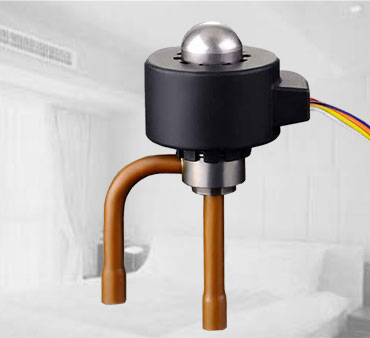
Within a certain opening degree of the electronic expansion valve, the cooling capacity increases with the increase of the opening degree of the electronic expansion valve. In this range, the opening of electronic expansion valve increases and the flow of refrigerant increases. When the heat exchanger is within its heat exchange saturation value, the heat exchange increases.
The results show that the refrigeration capacity can increase monotonously within 250 steps, and the increasing range is obvious. Using this monotonous rising range, when the current water tank temperature is lower than the set value, the researcher can calculate a smaller opening value of the electronic expansion valve by setting the corresponding PID parameters. The compressor provides a smaller cooling capacity, whose cooling capacity is less than the heat provided by the electric heater in the calorimeter, so the water tank temperature gradually increases.
Similarly, when the current water tank temperature is greater than the set value, the system calculates a larger opening value, so as to achieve the purpose of providing a larger cooling capacity by the compressor, and the cooling capacity is greater than the heat provided by the electric heater in the calorimeter. Therefore, the temperature of the water tank decreases gradually. When the temperature of the water tank is set near the straight position, the integral link of PID regulation can eliminate the static difference, improve the control accuracy, and make the temperature of the water tank stable.